Mouda farms face sharply different irrigation decisions in kharif, rabi and summer, and the right pipe depends on the crop, soil, water source and operating schedule. By the end, you can identify the installation window, estimate system capacity, compare pipe types and request a quotation that is usable when irrigation demand rises.
Key takeaways
- Install drip before planting crops that need controlled watering.
- Size emitters, laterals and mains from crop flow and field area.
- Design filters and pumps around the actual water source.
- Confirm pipe diameter, fittings, stock and delivery before purchase.
When do Mouda crops need drip irrigation most?
Install drip before planting vegetables, banana, orchards, floriculture, nurseries and suitable row crops—not as a direct substitute for continuously flooded rice. In Mouda, monsoon water supports kharif, but reliable irrigation matters more after the monsoon and through summer.
| Season | Crops and critical stages | Installation, flushing, repair or replacement |
|---|---|---|
| Kharif | Vegetables, chilli, cotton and other row crops during transplanting, establishment and flowering; banana and orchards during new growth | Install before field preparation or transplanting. Flush mains and laterals after installation and after silt enters with monsoon water. Repair crushed laterals before flowering. Rice remains better suited to basin or controlled-flood irrigation unless a specific non-flooded system is designed. |
| Rabi | Wheat, vegetables, onion, pulses and chickpea during germination, branching, bulb or pod formation, and grain filling | Install or recommission after the monsoon. Flush before the first irrigation, then inspect blocked emitters and leaking joiners during flowering and fruit or pod development. Replace brittle or repeatedly blocked laterals before the next crop. |
| Summer | Vegetables, melon, banana, orchard fruit and nursery plants during transplant recovery, canopy growth, flowering and fruit enlargement | Treat drip as most valuable when evaporation is high and rainfall is absent. Flush more frequently, repair sun-damaged lines promptly and replace laterals with widespread clogging or leaks before peak demand. |
A system sold as drip irrigation pipe for mouda still needs matching filters, joiners, replacement emitters and the correct roll length in stock before the planting window. Confirm component specifications if you intend to claim a Maharashtra micro-irrigation subsidy.
How do you size a drip system for a Mouda field?
Start with row geometry, not acreage. Measure cultivated area, crop-row spacing and the length of each row. A 1-hectare field with 1 metre row spacing has about 10,000 row metres; at 0.4 metre emitter spacing, that equals 25,000 emitters.
- Emitter demand: multiply emitter count by discharge. At 2 litres per hour, the example requires 50,000 litres per hour, or 50 m³/h, if the whole field runs together.
- Zone size: divide the source’s dependable operating flow by the required flow per zone. A borewell delivering 10 m³/h can serve about one-fifth of that example at once, before allowing for filtration and pressure loss.
- Operating time: check that the zones fit the irrigation window. If the crop needs 20 m³ per day and one zone delivers 10 m³/h, that zone must run for two hours daily.
- Lateral capacity: select the diameter, wall thickness and maximum length from the manufacturer’s pressure-loss data. A longer lateral or uphill row loses pressure and changes discharge, especially with non-pressure-compensating emitters.
- Pressure: confirm inlet pressure at the farthest emitter while the zone operates. Use a regulator, shorter laterals or more zones if pressure falls below the emitter’s operating range.
Available pump flow does not prove adequate design; verify pumping water level, electrical reliability and pressure under load. Obtain these figures before ordering drip irrigation pipe for Mouda, because two pipes with the same nominal diameter can carry different flows. Compare emitter discharge, spacing, roll length and maximum recommended lateral length.
How should the water source change the irrigation design?
Design for the source’s dry-season output, not its monsoon appearance. Verify discharge, pumping water level, available operating hours and electrical reliability before choosing pump capacity, storage or pipe diameter.
- Borewell: Match the pump to measured discharge and pumping water level, then use a screen or disc filter. Add a storage tank if the borewell cannot supply every zone during the available hours. Protect the pump from dry running and check pressure at the farthest lateral.
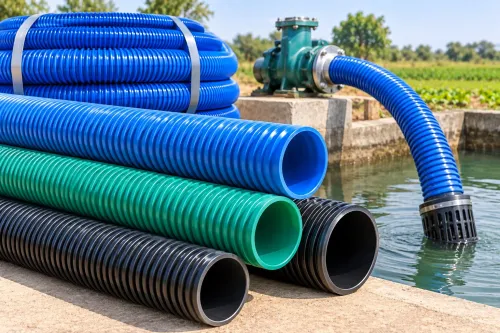
- Open well: Use a pump suited to changing water levels and fit a screened intake above the bottom sediment. Provide a settling stage, followed by screen or disc filtration, because silt will block emitters. Recheck suction, water level and pump output before rabi and summer operation.
- Canal: Do not feed a drip network directly from turbid canal water. Allow sediment to settle in a tank, then use media filtration followed by a screen or disc filter; a lift pump and pressure regulator are still required. Storage protects the schedule when canal rotations stop.
- Farm tank: Size storage for the longest expected supply gap and use a booster pump if gravity pressure cannot meet emitter requirements. Cover or fence the tank to limit algae, leaves and animal waste.
Flush filters, mains and laterals before each dry season, after storms and after fertigation. Use pressure-rated irrigation PVC pipe in Mouda installations; never substitute SWR pipe for a pressurised main.
Where do drip laterals, PVC mains and fittings belong?
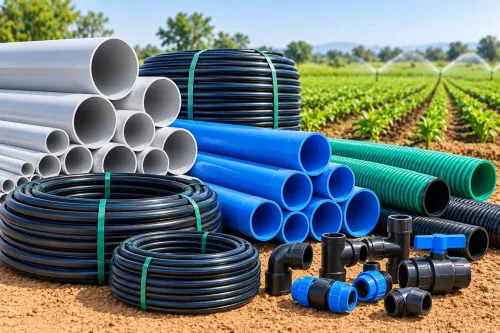
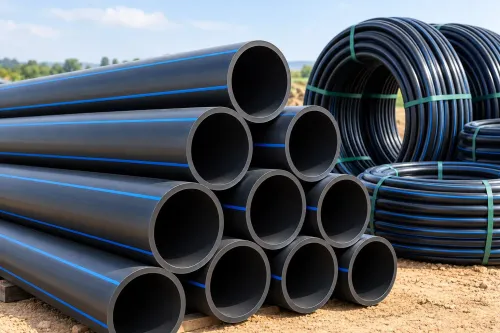
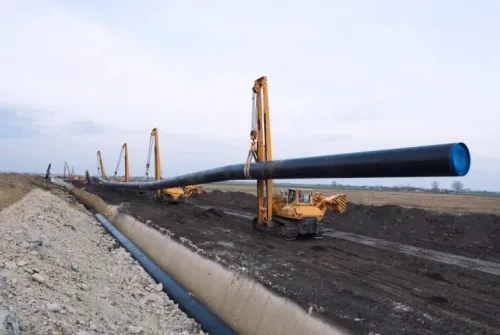
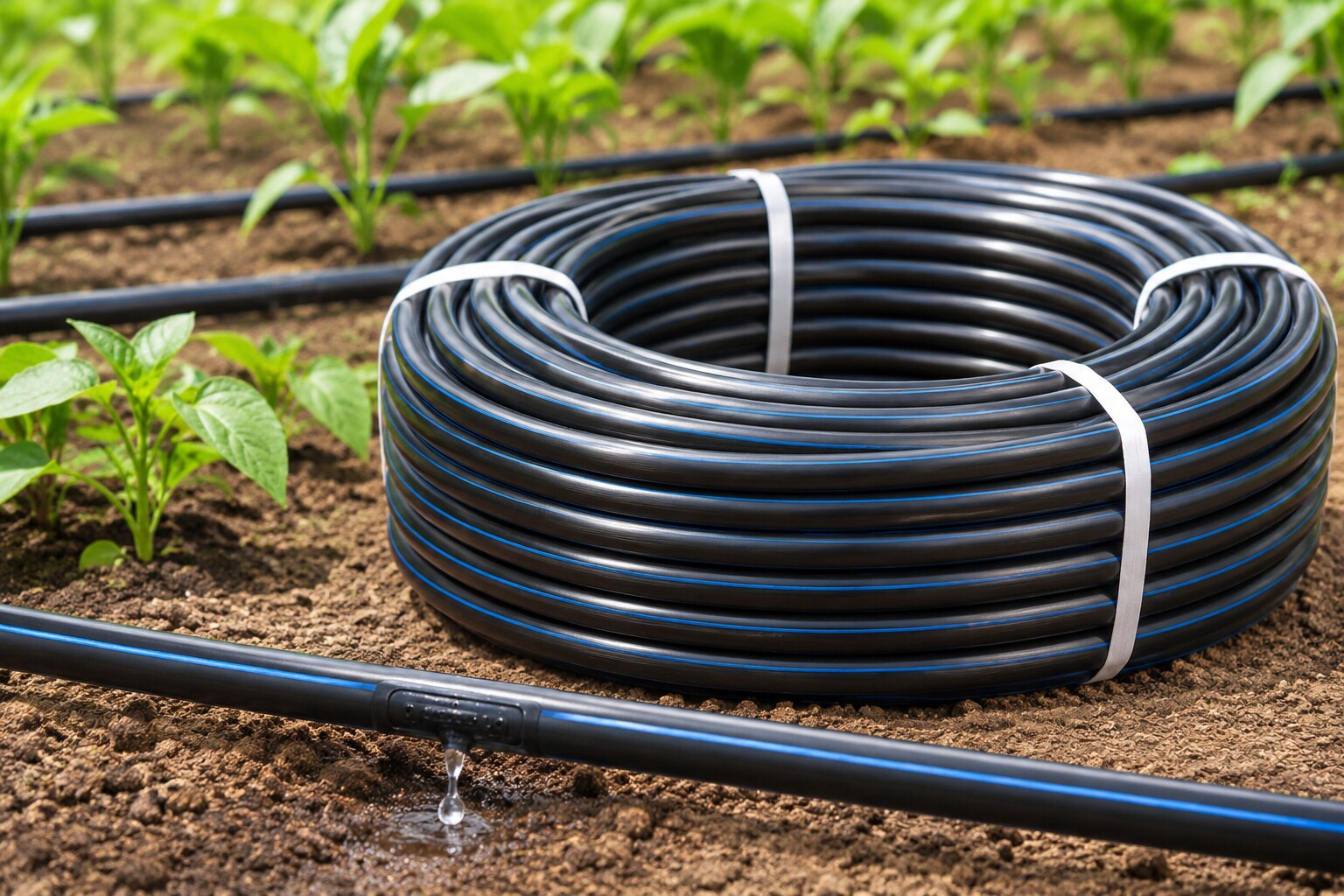
Build the network in this order: pump or tank outlet, filter, mainline, zone valve, pressure regulator, submain, take-offs and 16 mm drip laterals. Use pressure-rated PVC-U for buried, straight mainlines; use HDPE where the route is temporary, uneven or exposed to cultivation damage. SWR pipe is for soil, waste and rainwater discharge, not pressurised irrigation.
- Fit a screen or disc filter before the first valve; choose its rating for the emitter manufacturer’s requirement and clean it as pressure loss rises.
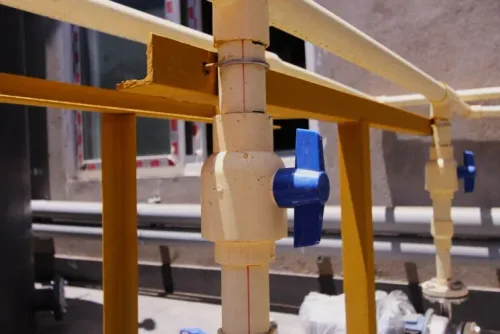
- Place a valve and pressure regulator at each zone inlet, then connect the submain to row take-offs with matching grommets, connectors or compression fittings.
- Close every lateral end with a flush valve or removable end cap, and provide a submain flush point; flushing without these outlets leaves silt inside the emitters.
- Split long or sloping rows into zones when inlet pressure cannot maintain even discharge. Check the lateral’s maximum length, wall thickness, emitter spacing, flow rate and pressure range before buying.
| Method | Best fit | Main limitation |
|---|---|---|
| Drip | Row crops, orchards and scarce water | Needs filtration, flushing and repairs |
| Flood or furrow | Level fields with abundant water | More evaporation, runoff and uneven wetting |
| Sprinkler | Closely spaced crops or germination | Wind drift, higher pumping demand and wet foliage |
Do not treat “drip irrigation pipe supplier Mouda” or “irrigation PVC pipe Mouda” as specifications. Confirm stock, roll length, replacement emitters and compatible fittings before installation.
How can you check Mouda pipe availability before buying?
Before paying a deposit, obtain written confirmation that the required pipe diameter, roll length and quantity are physically available for dispatch to Mouda. A search for drip irrigation pipe supplier mouda is only a starting point; two pipes with the same diameter can differ in discharge, pressure limits and maximum lateral length.
1. Request emitter discharge in litres per hour, nominal emitter spacing, wall thickness or class, operating-pressure range, recommended lateral length and warranty. Match these figures to your crop, row spacing, soil and available pump pressure.
2. Confirm stock by exact specification, not by product name. Ask for the number of rolls, roll length, batch details, replacement emitters, joiners, end closures, take-offs, valves and flush fittings. Check that the filter rating and pressure regulator suit the pipe.
3. Give the supplier your borewell or pump discharge, pumping water level, operating hours, electrical reliability and planned simultaneous zones. Otherwise, a correctly sized network can still run below emitter pressure.
4. Get a written dispatch date, transport method, unloading point and procedure for shortages or damaged rolls. Schedule delivery before land preparation and allow time for leak testing.
If you are seeking Maharashtra micro-irrigation subsidy, verify current Agriculture Department specifications, farmer documents, area limits and authorised installation rules before accepting a quotation. Geeta Plasticwood Industries can be compared on the same checklist rather than on price per metre alone.
Related products
 | Drip Irrigation Pipes Product Details: Pipe Diameter 16 mm Length of Pipe 300m Size/Diameter 16 mm Drip Spacing 15 cm Drip Emitter Outline Material LDPE Keeping in mind... View product → |
 | 3 Inch Agricultural PVC Pipe 3 Inch Agricultural PVC Pipe is a lightweight, durable, and corrosion-resistant piping solution ideal for irrigation and water supply in farming. View product → |
Frequently asked questions
When do Mouda crops need drip irrigation most?
Drip irrigation matters most after the monsoon and through summer for vegetables, banana, orchards, floriculture, nurseries and suitable row crops. It is not a direct substitute for continuously flooded rice.
How do you size a drip system for a Mouda field?
Start with crop spacing, emitter discharge, row length, irrigation hours and available flow. Use these figures to size drip laterals, submains, PVC mains, filters and the pump.
How should the water source change the irrigation design?
A borewell, open well, farm pond or canal supply changes the pump, filtration, storage and intake design. Test water quality and measure source flow before selecting pipe sizes.
Where do drip laterals, PVC mains and fittings belong?
Drip laterals run along crop rows, submains divide the field into irrigation zones, and PVC mains carry water from the pump or storage point. Use valves, filters, tees, elbows and end flush points at the required connections.
How can you check Mouda pipe availability before buying?
Give the supplier your pipe diameter, pressure class, length, fitting list, delivery location and required date. Confirm stock, batch details, compatible fittings, transport and replacement terms in writing.
Related products
 | 8 Inch Agricultural PVC Pipe 8 Inch Agricultural PVC Pipe is a strong, lightweight, and corrosion-resistant piping solution designed for efficient water flow in irrigation and... View product → |
 | 3.5 Inch Agricultural PVC Pipe 3.5 Inch Agricultural PVC Pipe Usage Agricultural Material PVC Shape Round 3.5 Inch Agricultural PVC Pipe is a lightweight, durable, and corrosion-resistant pipe designed for... View product → |
 | 1 Inch Agricultural PVC Pipe Material PVC Shape Round Usage/Application Agricultural 1 Inch Agricultural PVC Pipe is a lightweight, durable, and corrosion-resistant pipe designed... View product → |
 | Agricultural Pipes Product Details: Brand as per requirement Size/Diameter as per requirement Length of Pipe as per requirement Thickness as per requirement Material as... View product → |
Keywords