Choosing a farm water-conveyance system in Tumsar involves more than comparing the price of PVC pipe with a hose or open channel. By matching each section of the layout to discharge, distance, elevation, soil movement, irrigation method, and maintenance capacity, you can select a system that controls both water loss and lifetime operating cost.
Key takeaways
- Map the source, pump, mainline, outlets and drainage before choosing pipe.
- Size pipes using flow, route length and total dynamic head.
- Use PVC or HDPE after checking soil movement, joints and installation access.
- Compare installed cost, pressure, labour, repairs and water losses—not metre price alone.
Start with the farm layout, not the pipe catalogue
Begin with a route map: source, pump, mainline, submain, field outlets and drainage. A Tumsar rice farm can still need stored or pumped water after the monsoon’s roughly 1,250 mm rainfall, especially for rabi and summer crops. Do not specify one pipe for every section; suction, delivery, distribution and drainage perform different jobs.
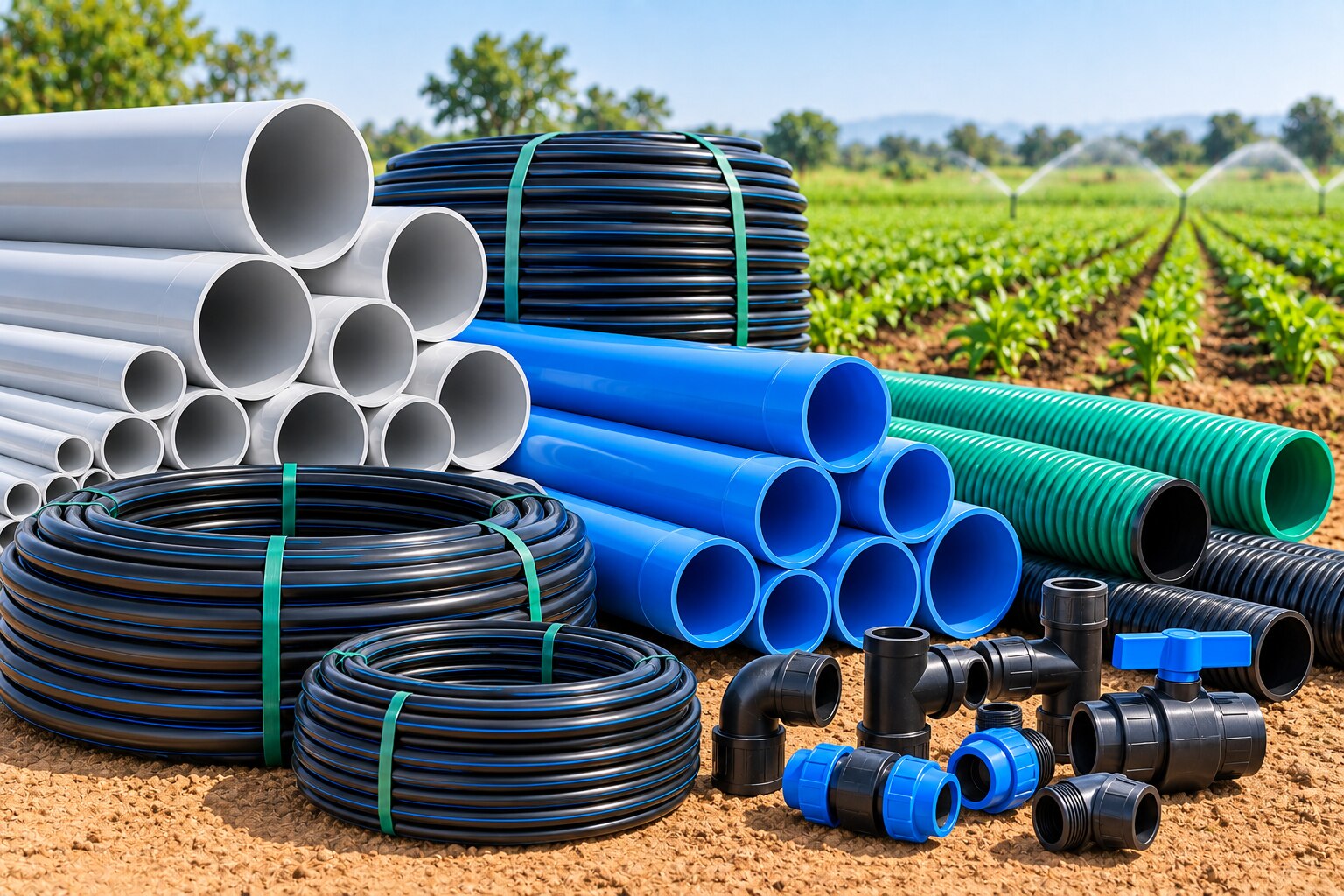
| Option | Farm location | When it applies |
|---|---|---|
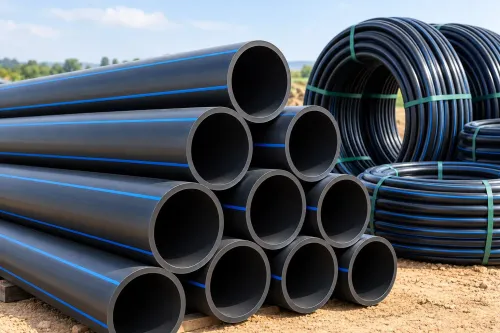
| HDPE or rigid PVC pressure pipe | Borewell or pump to buried mainline | Long, protected routes; bury it with supported joints and anchored bends in black cotton soil |
| Rigid PVC or HDPE | Field submain and sprinkler riser | Branches that need stable pressure and inspection at valves |
| LDPE dripline | Along crop rows after filtration | Precise root-zone irrigation; replace blocked or damaged laterals instead of treating them as mains |
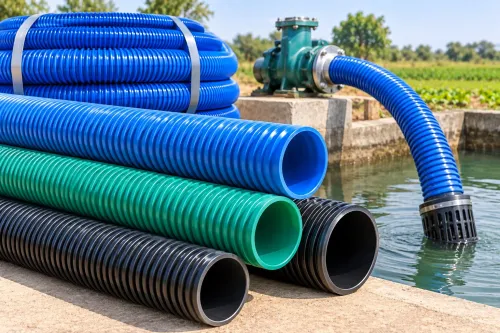
| Flexible hose | Temporary pump delivery or movable outlet | Short seasonal runs where tractors, UV and handling are manageable |
| Open channel | Farm boundary or low-slope field conveyance | Low-cost gravity movement where land allows it; expect seepage, weed growth and evaporation |
| Perforated drainage pipe | Low points and waterlogged areas | Subsurface drainage only, never pressurised irrigation |
For agricultural pipes tumsar buyers, the agricultural pipes or other options tumsar decision should also cover the pump’s suction pipe, delivery pipe and drainage separately. Ask for IS 14151 for irrigation uPVC, IS 4984 for polyethylene water-supply pipe, or the applicable standard, plus SDR or pressure class, dimensions, batch number and test records.
Keep an as-built route map, flushing points and accessible valves.
Size the pipe from flow, distance and total dynamic head
The pump outlet is only a connection size; it does not determine the farm main’s diameter. Size the line for required flow, route length and total dynamic head (TDH), which combines static lift, elevation changes, outlet pressure, pipe friction, filters, valves and fittings.
- Set the required discharge from the irrigation method: total sprinkler demand, submain demand or the number of drip zones operating together.
- Measure the longest route and its rise from the pump to the farthest outlet.
- Calculate friction loss using the pipe’s actual internal diameter, not its nominal inch label. Include losses through elbows, tees, reducers, valves and filters.
- Check the pump curve at the calculated TDH. Confirm that the farthest outlet still receives its required pressure when other outlets run.
| Pipe choice | What it changes | When it applies |
|---|---|---|
| Outlet-size pipe | Lowest purchase cost, but higher friction loss over distance | Short delivery runs with modest flow |
| Larger mainline | Lower friction, better far-end pressure and lower energy demand | Long routes, high discharge or substantial elevation rise |
| Smaller branch line | Limits flow and reduces unnecessary material | Individual zones, risers or short field sections |
A larger pipe can cost more initially yet prevent weak sprinkler patterns, low drip pressure and excessive pump electricity. Do not force the entire system to match the pump outlet: use a suitable reducer or expander at the connection, then size each section for its own flow.
A farm pipe comparison for Tumsar should record internal diameter, wall thickness, pressure class, joint type and available fittings. That comparison matters more than nominal size or price per metre.
PVC or HDPE for buried mains in Tumsar's black soil?
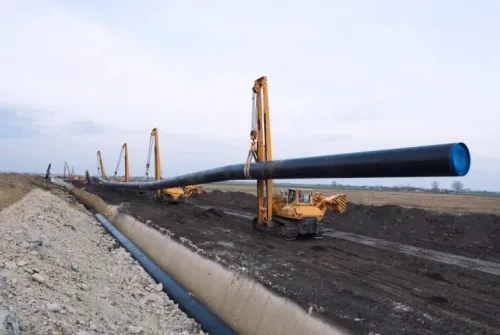
Rigid PVC is the better buried-main choice when the Tumsar route is straight, the trench can be prepared properly, and installation cost matters. Its rigid wall holds a stable alignment, its smooth bore limits friction loss, and solvent-welded or elastomeric joints suit long, undisturbed runs.
HDPE justifies its higher installation discipline when black cotton soil is likely to shrink and swell, the route crosses vehicle paths, or the main needs to follow uneven ground with fewer joints.
Its flexibility absorbs ground movement and impact better, but butt-fusion or electrofusion demands clean pipe ends, correct heating, alignment, pressure, and an operator who records the fusion work.
| Option | Prefer it when | Main risk to control |
|---|---|---|
| Rigid PVC | Straight buried runs with stable support and planned fittings | Cracked pipe or leaking joints from bending, impact, poor solvent preparation, or early loading |
| HDPE | Moving soil, crossings, curved routes, or impact-prone sections | Failed fusion from contamination, wrong heating, misalignment, or unverified bead quality |
For either material, compact the trench bottom, provide continuous side support, and anchor bends, tees, reducers, valves, and the pump-discharge transition. Mark valve and flushing points, protect crossings, and keep an as-built route map; a strong pipe still fails when fittings move.
Ask an agriculture PVC pipes manufacturer Tumsar to state the pipe’s pressure class, wall thickness, joint method, and installation limits. Geeta Plasticwood Industries is useful for that specification discussion when a farm pipe comparison Tumsar order involves matching PVC to the actual buried route rather than choosing by nominal diameter alone.
Related products
 | Agricultural Pipes Product Details: Brand as per requirement Size/Diameter as per requirement Length of Pipe as per requirement Thickness as per requirement Material as... View product → |
 | 3 Inch Agricultural PVC Pipe 3 Inch Agricultural PVC Pipe is a lightweight, durable, and corrosion-resistant piping solution ideal for irrigation and water supply in farming. View product → |
Choose between hose, dripline, sprinkler pipe and open channels
Use a buried pressure main for permanent, long routes; choose another option when access, mobility, application, or gravity flow matters more than protection and low evaporation.
| Option | Use it when | Main limitation |
|---|---|---|
| Flexible hose | You move water between plots, connect a pump temporarily, or irrigate a small area without fixed valves. | Kinking, punctures, UV exposure, and higher friction make it poor for long permanent runs. |
| Dripline | Crops are planted in rows and you want water at the root zone with controlled discharge. | It needs filtration, pressure regulation, flushing, and seasonal replacement; it cannot replace the high-flow mainline. |
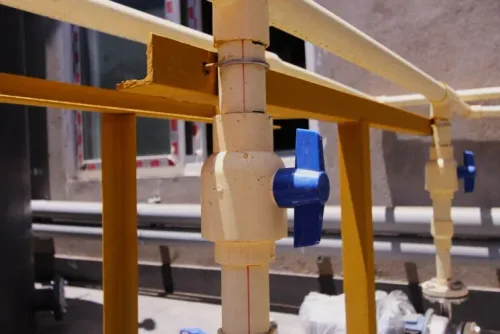
| Rigid above-ground pipe | You need a visible route that workers can inspect, extend, or alter frequently. | Tractors, livestock, sunlight, and heat damage it unless crossings and supports are protected. |
| Open channel | Water travels by gravity over a short, gentle route and the land allows a stable, accessible alignment. | Seepage, weeds, silt, evaporation, and breaches waste water and make delivery uneven. |
Use a flexible hose after the pump or from a field submain, not as suction pipe unless its wall is rated against collapse. Use smooth solid-wall pressure pipe for delivery; perforated HDPE drainage pipe is designed to admit water, not carry irrigation pressure.
For agricultural pipes in Tumsar, rigid above-ground PVC or HDPE suits a temporary field submain, while a buried main suits crossings, long distances, and routes exposed to tractors. Keep valves and flushing points accessible, and record the buried route before covering it.
Compare the installed system, not only the price per metre
Price per metre hides the installed cost. Compare the full route: pipe, excavation or supports, fittings, valves, pump electricity, repairs and the labour needed to replace a failed section.
| Option | Purchase and installation | Operating and replacement burden |
|---|---|---|
| Buried PVC or HDPE main | Pipe plus trenching, crossings, valves and flushing points | Lower UV and impact exposure; repairs require the route map and excavation |
| Above-ground rigid pipe | Lower digging cost; stronger supports and protection at crossings | Easy inspection, but tractors, livestock and sunlight increase damage risk |
| Open channel | Low pipe cost, but land shaping and crossings consume space | Evaporation, weeds, silt and cleaning add recurring labour; no pressure at the field edge |
Calculate electricity from the required flow and total dynamic head, not the pump outlet size. A smaller pipe can save at purchase but increase friction, reduce far-end pressure and raise every pumping bill.
Keep suction pipe, delivery pipe, mainline, submain, riser, drip lateral and drainage pipe as separate comparisons. They do not share the same pressure, filtration, UV or jointing requirements.
Before ordering, request actual internal diameter, wall thickness, pressure class or SDR, temperature derating, jointing method, roughness assumption, UV formulation, warranty exclusions and local replacement-fittings availability. Check batch traceability and test documents against IS 14151 for irrigation, IS 4984 for polyethylene water pipe or IS 4985 for uPVC potable-water pipe.
This makes an agricultural pipes or other options tumsar decision a genuine farm pipe comparison tumsar, not a catalogue-price contest.
Frequently asked questions
How should you plan an agricultural pipe layout for a Tumsar farm?
Map the water source, pump, mainline, submain, field outlets and drainage first. Assign separate pipe types to suction, delivery, distribution and drainage because each section has different demands.
How do you size agricultural pipes for a farm?
Use the required flow, route distance and total dynamic head. Include elevation change, pipe-friction loss, fittings, valves and the pressure needed at the outlet before selecting diameter.
Is PVC or HDPE better for buried mains in Tumsar's black soil?
Compare the route, soil movement, joint method, access for repairs and pressure requirements. Select the material that suits installation conditions rather than choosing only by purchase price.
When should you choose hose, dripline, sprinkler pipe or an open channel?
Choose based on crop spacing, field shape, pressure, labour, water control and acceptable losses. Dripline suits targeted application, sprinkler pipe suits pressurised coverage, hose suits flexible short runs, and open channels suit suitable low-pressure layouts.
Related products
 | 8 Inch Agricultural PVC Pipe 8 Inch Agricultural PVC Pipe is a strong, lightweight, and corrosion-resistant piping solution designed for efficient water flow in irrigation and... View product → |
 | 3.5 Inch Agricultural PVC Pipe 3.5 Inch Agricultural PVC Pipe Usage Agricultural Material PVC Shape Round 3.5 Inch Agricultural PVC Pipe is a lightweight, durable, and corrosion-resistant pipe designed for... View product → |
 | 1 Inch Agricultural PVC Pipe Material PVC Shape Round Usage/Application Agricultural 1 Inch Agricultural PVC Pipe is a lightweight, durable, and corrosion-resistant pipe designed... View product → |
 | Drip Irrigation Pipes Product Details: Pipe Diameter 16 mm Length of Pipe 300m Size/Diameter 16 mm Drip Spacing 15 cm Drip Emitter Outline Material LDPE Keeping in mind... View product → |
Keywords