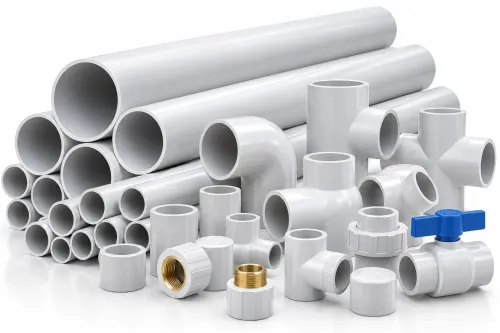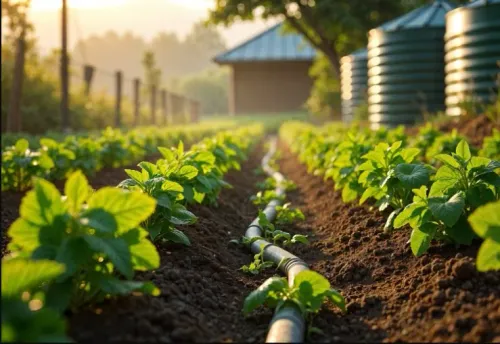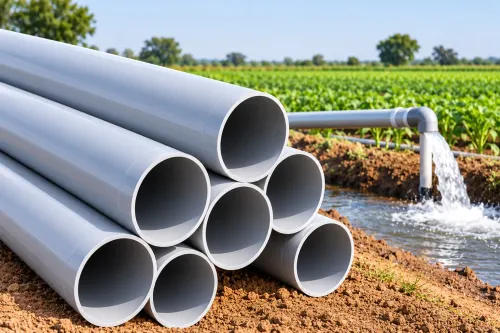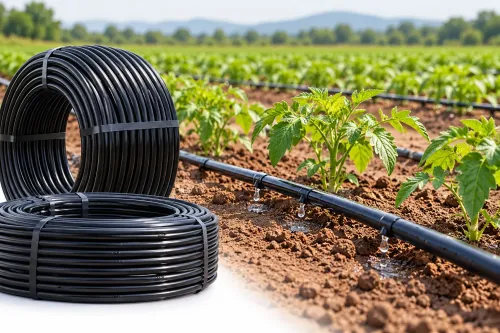
Choosing a farm pipeline by inch size or the word “HDPE” can leave you with excess pump losses, incompatible fittings or joints that fail under movement. You will be able to compare HDPE and PVC-U, size a line from its hydraulic duty, specify a 110 mm PE 80 pipe correctly and screen suppliers before installation.
Key takeaways
- Choose HDPE for settlement, bends and exposed impact; choose PVC-U for straight protected runs.
- Size the line from flow, length, elevation and pressure—not diameter alone.
- Use butt fusion for permanent HDPE joints and compression fittings for field repairs.
- Specify bedding, cover depth, UV protection and vehicle-load protection before installation.
HDPE or PVC-U: which material fits each farm pipeline job?
For a Multai farm, choose HDPE for ground that moves and PVC-U for a straight, protected alignment. The decision depends on settlement, vehicle loading, sunlight, jointing method and pressure duty—not a search term such as hdpe pipe multai.
| Material | Best fit | Main limitation |
|---|---|---|
| HDPE | Buried mainlines, borewell delivery lines and routes facing impact, vehicle loads or minor settlement | Keep within the specified bend radius; coil memory, ovality and end preparation affect joints |
| PVC-U | Rigid, straight routes using solvent-cement sockets or elastomeric-ring joints | Do not bend it to force alignment or use it as a lever at a fitting; use manufactured bends |
| HDPE or PVC-U | Pump discharge and field distribution | Select a pressure-rated mainline and suitable submain; use separate low-pressure laterals for emitters |
HDPE coils reduce field joints and tolerate movement better, while PVC-U provides higher ring stiffness for a given installation class. HDPE is the wrong choice when the design requires a specific PVC solvent-weld system, rigid alignment, a suction-rated assembly or another defined pressure class.
Treat suction lines separately: vacuum resistance, wall stiffness and pump connections control the choice. For exposed HDPE, specify UV-stabilised material, restrain the route and allow thermal movement.
A 20°C pressure rating does not automatically cover hot black pipe in direct sun; temperature can reduce allowable pressure and rigid fixings can load tees, valves and pump connections.
How do you size the line and interpret a 110 mm PE 80 pipe?
Size the line from pump discharge, total run length, elevation difference, required outlet pressure and the friction-loss budget you can accept. Add losses through filters, valves, bends, non-return valves and fittings before choosing the pipe; then check velocity and water-hammer risk when a valve closes quickly or a pump trips.
Nominal labels do not equal hydraulic bore. Confirm actual outside diameter, wall thickness, internal diameter and fitting standard before matching 1 inch, 3 inch, 3.5 inch, 8 inch or 110 mm descriptions to a pump, valve, PVC line or irrigation branch.
A 110 mm PE 80 listing gives a nominal outside diameter and material strength class, not a complete pressure-line specification. Ask for:
- IS 4984 compliance, SDR or wall thickness, pressure class, design coefficient, temperature basis and service medium.
- The lot identification, dimensional records and pressure-test requirements for the quoted pipe and fittings.
SDR means outside diameter divided by wall thickness; a lower SDR has a thicker wall. At about 20°C, PE100 SDR 11 is commonly near PN 16 and SDR 17 near PN 10, but the standard, fittings and temperature determine the usable rating.
PE 80 alone does not prove suitability for a pump line, rising main or surge condition.
| Description | What it identifies | What you still need |
|---|---|---|
| 110 mm PE 80 | Nominal outside diameter and material grade | Bore, wall, SDR, pressure rating and temperature basis |
| 1, 3, 3.5 or 8 inch | Nominal size label | Actual dimensions and compatible standard |
| Search phrase | “plastic pipe manufacturer multai” or “agriculture pvc pipes manufacturer multai” | Manufacturing source, documentation and hydraulic suitability |
Which jointing method gives the best balance of strength and field repair?
A properly made butt-fusion joint gives the strongest permanent mainline; electrofusion gives the better balance when repairs, tie-ins or restricted excavations matter. Choose the jointing system before ordering pipe because each method requires different equipment, skill and inspection.
| Option | Equipment and controls | Best field use |
|---|---|---|
| Butt fusion | Facing machine, controlled heater temperature, alignment, bead formation, heating and cooling times; record fusion parameters and reject misaligned or poorly formed beads. | Long, permanent buried mains |
| Electrofusion | Electrically heated fittings, clean scraped surfaces, correct clamping and a readable fusion record. | Repairs, tie-ins and confined excavations |
| Compression | Correct insertion depth, grip rings, seals and restraint; inspect after pressure testing. | Smaller branches and field changes |
| Flanged | Stub end, backing ring, gasket and correctly tightened bolts. | Pumps, valves and HDPE-to-metal or HDPE-to-PVC transitions |
Solvent cement does not bond HDPE. Never use a plain threaded plastic adapter on a vibrating pump or unsupported bend; the pipe-to-fitting transition often fails before the pipe wall.
Use rated flanges, approved transition fittings or the manufacturer’s connection detail. Compare fusion-equipment access, trained operators, spare fittings and repair access in Multai, not only the quoted pipe price. Searches for PVC pipe suppliers Multai should also lead you to verify fitting compatibility and the crew’s jointing method.
What installation details protect a buried or exposed farm line?
Set trench depth, bedding thickness and cover from the selected IS standard, road loading, soil and local design—not a generic number. Remove sharp stones, provide continuous bedding and compact side support before controlled backfill; poor embedment still deforms flexible HDPE. A Multai farm using hdpe pipe needs this project-specific detail.
1. Keep the pipe within its specified minimum bend radius. Control coil memory and ovality, and complete end preparation before fitting; never pull a coiled end directly into a compression fitting or flange.
2. Allow movement on long exposed runs instead of rigidly fixing every point. Use UV-stabilised HDPE and protect it from machinery and livestock.
3. Anchor valves, tees, reducers and pump connections with a detail that transfers thrust safely into the support structure.
4. Use sleeves or increased cover at road crossings, and mark the route before cultivation.
5. Review air-release points on rising sections, drain points at low spots and valve-closing times for water hammer.
6. Pressure-test the completed line at the specified pressure and duration, including buried branches, saddles, valves and end closures; pump-outlet testing alone can hide leaks. Recheck pressure class when water temperature, direct sun or unusual operating cycles exceed the reference design condition.
What should you verify before selecting a Multai pipe supplier?
Before selecting a Multai supplier, demand a project-specific quotation, not a catalogue label. It must identify:
| Quote item | What to verify | Why it matters |
|---|---|---|
| Standard | IS 4984 for polyethylene water-supply pipe, or IS 4985 for PVC-U potable-water pipe where applicable | Confirms the product basis |
| Dimensions | Actual outside diameter, wall thickness or SDR, length and colour | Prevents fitting and quantity errors |
| Material and rating | Material grade, pressure class and temperature basis | A 20°C rating does not automatically cover hot, exposed pipe |
| Quality records | Lot identification and dimensional inspection records | Enables traceability and acceptance checks |
| Testing | Hydrostatic test requirements and a written site pressure-test procedure | Testing only at the pump outlet can miss buried branch leaks |
For fused HDPE, require fusion-record forms and name the person responsible for inspecting and repairing joints. Confirm whether the seller manufactures the quoted pipe or sources it from another plant; check that plant’s location, traceability, fitting compatibility, delivery condition and local installation support.
These checks distinguish searches for hdpe pipe manufacturer multai, plastic pipe manufacturer multai, pvc pipe suppliers multai and agriculture pvc pipes manufacturer multai. Geeta Plasticwood Industries belongs in the comparison when it supplies this documentation for the proposed PVC, HDPE or related system.
Compare pipe, fittings, valves, transitions, testing and support as one installed package. Reject any quote that says only “HDPE” or “PVC” without the standard, grade, dimensions and pressure or SDR information.
Related products
 | Agricultural Pipes Product Details: Brand as per requirement Size/Diameter as per requirement Length of Pipe as per requirement Thickness as per requirement Material as... View product → |
 | 3 Inch Agricultural PVC Pipe 3 Inch Agricultural PVC Pipe is a lightweight, durable, and corrosion-resistant piping solution ideal for irrigation and water supply in farming. View product → |
Frequently asked questions
Is HDPE or PVC-U better for a Multai farm pipeline?
Choose HDPE where soil movement, settlement, bends or impact are concerns. Choose PVC-U for a straight, protected alignment with controlled installation.
How should you size a farm water line?
Start with required flow, pipeline length, elevation change, operating pressure and acceptable friction loss. Then select the diameter and pressure class that meet those conditions.
What does 110 mm PE 80 mean?
110 mm identifies the pipe outside diameter. PE 80 identifies the polyethylene material strength classification; confirm the wall thickness, SDR and pressure rating before purchase.
Which HDPE jointing method is best for farm work?
Butt fusion provides a permanent, strong joint for compatible pipe and trained operators. Compression fittings are easier to remove and suit field repairs or connections to other materials.
How can you protect a buried or exposed farm pipeline?
Provide stable bedding, remove sharp stones, compact the backfill in layers and protect the line from vehicle loads. Support exposed pipe, allow for thermal movement and use UV-rated material where sunlight is continuous.
Related products
 | 3.5 Inch Agricultural PVC Pipe 3.5 Inch Agricultural PVC Pipe Usage Agricultural Material PVC Shape Round 3.5 Inch Agricultural PVC Pipe is a lightweight, durable, and corrosion-resistant pipe designed for... View product → |
 | 8 Inch Agricultural PVC Pipe 8 Inch Agricultural PVC Pipe is a strong, lightweight, and corrosion-resistant piping solution designed for efficient water flow in irrigation and... View product → |
 | Drip Irrigation Pipes Product Details: Pipe Diameter 16 mm Length of Pipe 300m Size/Diameter 16 mm Drip Spacing 15 cm Drip Emitter Outline Material LDPE Keeping in mind... View product → |
 | 1 Inch Agricultural PVC Pipe Material PVC Shape Round Usage/Application Agricultural 1 Inch Agricultural PVC Pipe is a lightweight, durable, and corrosion-resistant pipe designed... View product → |
Keywords